
Coating used on chicken coops promises to slash indoor temperatures and help millions of people get a good night’s sleep
When the summer heat hits South Africa’s townships, it turns shacks into ovens.
Informal dwellings made of little more than wood and corrugated metal sheets can reach 35C inside during the day and only fall to 25C during the middle of the night.
More formal buildings made of bricks and roofing tiles do not get as hot, but cool down more slowly as the walls retain the heat. While this is good in the winter, it can be stifling in summer.
Millions of South Africans live in such settlements, and during the hot months, daily routines can be dictated by their sweltering housing conditions.
Residents cannot easily rest, work or cook inside until their homes have cooled. At night they cannot sleep until late.
High crime rates make it difficult to leave doors and windows open unattended to help the homes cool down.
“At night it gets very difficult to go to bed and people tend to go to bed very late because it’s difficult to sleep when it’s hot,” explains Nandi Sinyanya, who lives in Khayelitsha, Cape Town’s largest township.
“We end up sitting until it gets cool, which takes a long time.”
She finds it difficult to cook until the temperature has dropped and her daughter cannot do her homework. Air conditioning is not an option and even a fan is a luxury.

Doctors estimate the optimum temperature for a good night’s rest is from around 16C to 18C.
Getting to bed at a reasonable time and getting a good night’s sleep is about more than fending off yawns in the morning.
Many of those lucky enough to have a job amid Kayelitsha’s high unemployment have to get up as early as 4am to get mini-bus taxis into the city to start early shifts as labourers and service workers.
Poor sleep also has a deeper health impact.
Studies have linked poor sleep to non-communicable diseases and problems including high blood pressure and diabetes.
The problem is wider than just in South Africa. Across the world, around a billion people live in similar informal settlements and climate change means temperatures for many of them are forecast to rise.
Sub-Saharan Africa in particular is often predicted to fare particularly badly from rising temperatures.
An experiment in two African countries is now looking at a simple innovation that could therefore have a significant effect for a huge number of people.
Researchers are investigating the effect of painting roofs with reflective paint.
The experiment will look at not only what impact the paint has on internal temperatures, but also at how it affects the quality of people’s sleep and their physiology.

Dr Modi Mwatsama, head of capacity and field development for climate and health at Wellcome, the charitable foundation funding the research, said: “Over 1 billion people worldwide live in informal settlements, where they have limited or no means of protecting themselves from rising temperatures, posing serious health risks.
“Simple interventions, like applying reflective paint to roofs, could potentially have significant benefits – lowering indoor temperatures and improving health and well-being.
“Studies like these will begin to improve our understanding so that in the future, we can design and deliver climate change adaptations that also protect people’s health.”
The Heat Adaptation Benefits For Vulnerable Groups in Africa (HABVIA) study run by scientists in South Africa, Ghana and the UK is researching the impact of the reflective paint on two test sites in Ghana and two sites in South Africa, including Khayelitsha.
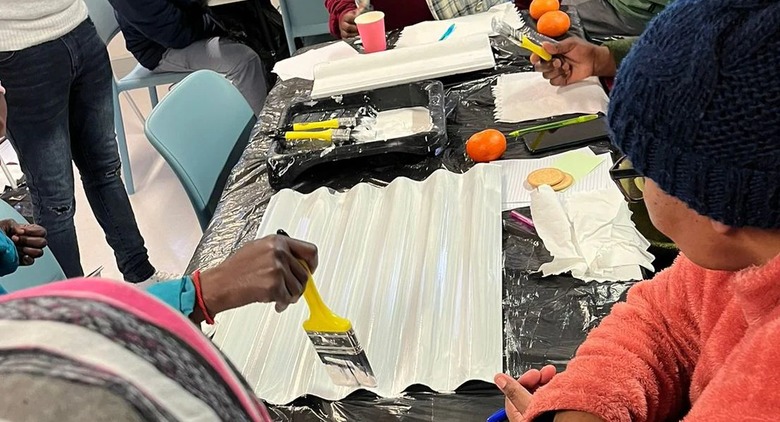
A total of 120 dwellings are having their roofs painted across the four sites and a similar number are being left unpainted as controls.
The special reflective paint, called Rhinoluxe Heat Reflect, has previously been used on chicken coops to reduce temperatures and the manufacturers say it can cut temperatures by anywhere from 2C to 8C.
Its high ‘brilliant white’ pigment load is designed to enhance infrared reflection, while UV-resistant additives and stabilisers protect against fading and degradation.

The paint costs around £100 for each dwelling.
Researchers painted the roofs late last year and have since been monitoring the results.
Not only are they following the ambient temperature inside each home, but they are also intensely monitoring the physiological effects on the residents, particularly the effect on their sleep.
Lara Dugas, one of the study’s principal investigators and chair in non-communicable disease epidemiology at the University of Cape Town, said: “When people are in very extreme hot heat environments where they are unable to get proper sleep, then we know that they are going to be at more risk for the non-communicable diseases.”
Those taking part wear sensitive wrist monitors which can accurately tell when they are asleep and when they are moving or active.
Body temperatures are recorded, as are biochemical measures like hydration, blood pressure, glucose and kidney function.
The data is still being collated, but early anecdotal evidence suggests those taking part have noticed a difference.
“People are not getting enough sleep. The effects that come with heat are great. Their sleep patterns are highly affected, said Ms Sinyanya, who is working as a community organiser for the Khayelitsha test site. “I am curious to see how it is going to have an effect.”
From The Telegraph
By Ben Farmer